
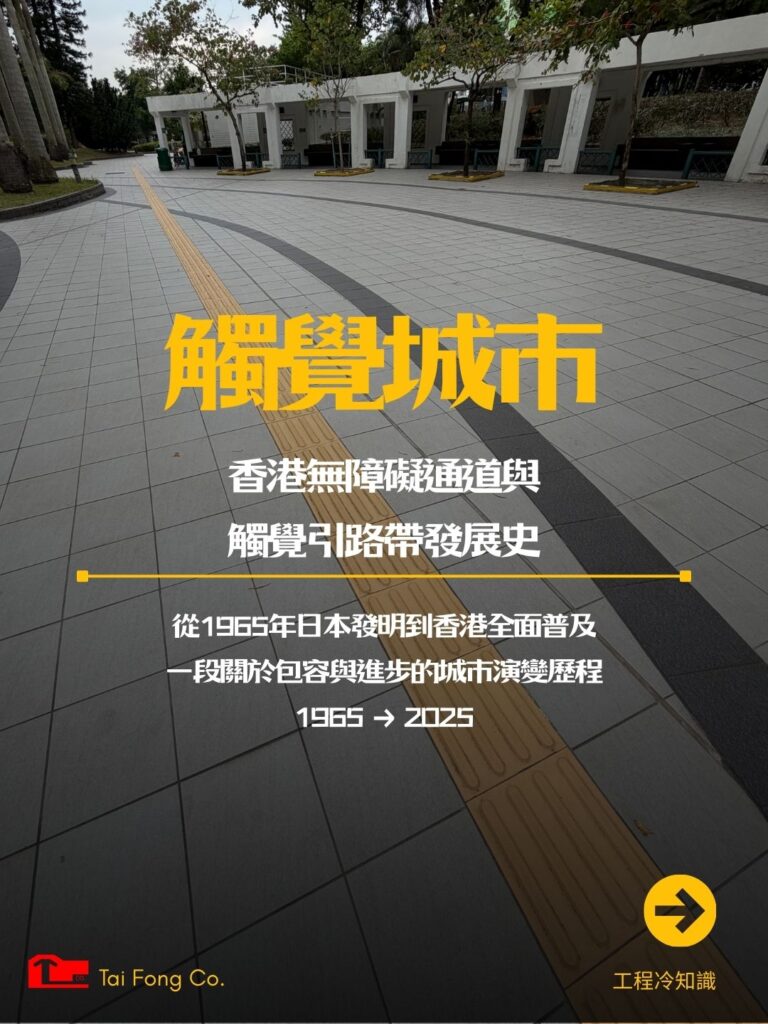
 觸覺城市:香港無障礙通道與觸覺引路帶發展史
從1965年日本發明到香港全面普及——一段關於包容與進步的城市演變歷程
—
引言
在香港繁忙的街道上,黃色凸起的地磚隨處可見。這些被稱為「觸覺引路帶」或「導盲磚」的設施,是視障人士獨立出行的重要依靠。本文將帶您回顧這套「地面語言」的發展歷程,了解香港如何從零開始,建構出今日的無障礙城市網絡。
—

一、全球起源:三宅精一的發明
1965年,日本發明家三宅精一(Seiichi Miyake, 1926-1982)為了幫助一位視力逐漸衰退的好友,受盲文啟發,自費研發出帶有凸起紋理的地面磚,命名為「點字磚」(Tenji Blocks)。
1967年3月18日,世界首條觸覺引路徑在日本岡山縣盲人學校外鋪設,標誌著城市導航進入觸覺時代。此後,日本國有鐵路於1977年起全線強制安裝,而英國、美國、澳洲等西方國家則在1990年代才相繼採用。
—

二、觸覺磚的三種「語法」
觸覺引路帶是一種空間語言,透過不同紋理向視障者傳達導航指令:
| 磚種 | 紋理 | 含義 |
|——|——|——|
| 方向磚 | 平行條紋 | 前進(GO) |
| 警示磚 | 大圓點 | 停止(STOP) |
| 位置磚 | 小圓點 | 轉向(TURN) |
—


三、香港發展里程碑
– 1984年:政府發布首份《設計手冊:傷殘人士通道》
– 1997年:《設計手冊:暢通無阻的通道》確立法律強制力
– 1998年:機場快線通車,引入觸覺車站地圖
– 2008年:新版設計手冊引入「通用設計」理念
– 2010年:平機會調查報告揭露設施缺陷
– 2012年:「人人暢道通行」計劃投入32.6億港元
—

四、路政署標準 H5118E
現時香港觸覺磚須符合路政署標準圖則H5118E,主要規格包括:
– 方向磚:條紋寬22-34mm,間距75mm,高度5mm
– 警示磚:圓點直徑25-35mm,間距50mm,高度5mm
– 位置磚:圓點直徑12-23mm,間距60mm,高度5mm
– 防滑標準:AS 4586濕擺測試

—

五、大方公司的承諾
大方公司自1983年成立以來,四十年來一直為香港政府及私人發展商供應優質建築材料,包括符合路政署標準的觸覺磚產品。我們深信,無障礙設施不僅是法規要求,更是城市文明的體現。
如有任何查詢,歡迎聯絡我們。
—
大方公司 Tai Fong Co. (Tiles & Granite)
電郵:[email protected]
網站:https://taifong.hk/
—
觸覺磚、導盲磚、盲人磚、無障礙設施、無障礙通道、H5118E、路政署標準、建築材料、大方公司
Title: Tactile City: The Evolution of Barrier-Free Access and Tactile Guide Paths in Hong Kong
Subtitle: From a 1965 Japanese invention to citywide implementation—a story of inclusion and urban progress
—
Introduction
On Hong Kong’s busy streets, yellow raised tiles are a common sight. Known as “tactile guide paths” or “tactile paving,” these installations are essential for visually impaired individuals to navigate independently. This article traces the development of this “ground language” and how Hong Kong built its barrier-free urban network from scratch.
—
1. Global Origins: Seiichi Miyake’s Invention
In 1965, Japanese inventor Seiichi Miyake (1926-1982) created textured floor tiles to help a friend who was losing his sight. Inspired by Braille, he named them “Tenji Blocks.”
On 18 March 1967, the world’s first tactile path was installed outside a school for the blind in Okayama, Japan. By 1977, Japan National Railways mandated installation across all stations. Western countries including the UK, US, and Australia adopted the system in the 1990s.
—
2. The Three “Grammar Rules” of Tactile Tiles
Tactile guide paths function as a spatial language, conveying navigation commands through texture:
| Tile Type | Pattern | Meaning |
|———–|———|———|
| Directional | Parallel bars | GO |
| Hazard Warning | Grid dots | STOP |
| Positional | Staggered dots | TURN |
—
3. Hong Kong Milestones
– 1984: First “Design Manual: Access for the Disabled” published
– 1997: Barrier-free requirements given legal force
– 1998: Airport Express opens with tactile station maps
– 2008: Universal Design principles introduced
– 2010: Equal Opportunities Commission investigation reveals deficiencies
– 2012: Universal Accessibility Programme invests HK$3.26 billion
—
4. Highways Department Standard H5118E
Hong Kong tactile pavers must comply with Standard Drawing H5118E:
– Directional tiles: Strip width 22-34mm, spacing 75mm, height 5mm
– Warning tiles: Dot diameter 25-35mm, spacing 50mm, height 5mm
– Positional tiles: Dot diameter 12-23mm, spacing 60mm, height 5mm
– Slip resistance: AS 4586 Wet Pendulum Test
—
5. Tai Fong Company’s Commitment
Since 1983, Tai Fong Company has supplied quality building materials to government and private developers in Hong Kong, including tactile pavers meeting Highways Department standards. We believe barrier-free facilities are not merely regulatory requirements—they reflect urban civilisation.
For enquiries, please contact us.
—
Tai Fong Co. (Tiles & Granite)
Email: [email protected]
Website: https://taifong.hk/
—
Keywords: tactile paving, tactile tiles, barrier-free access, accessibility, H5118E, Highways Department, building materials, Tai Fong Company, Hong Kong