
【工程知識】
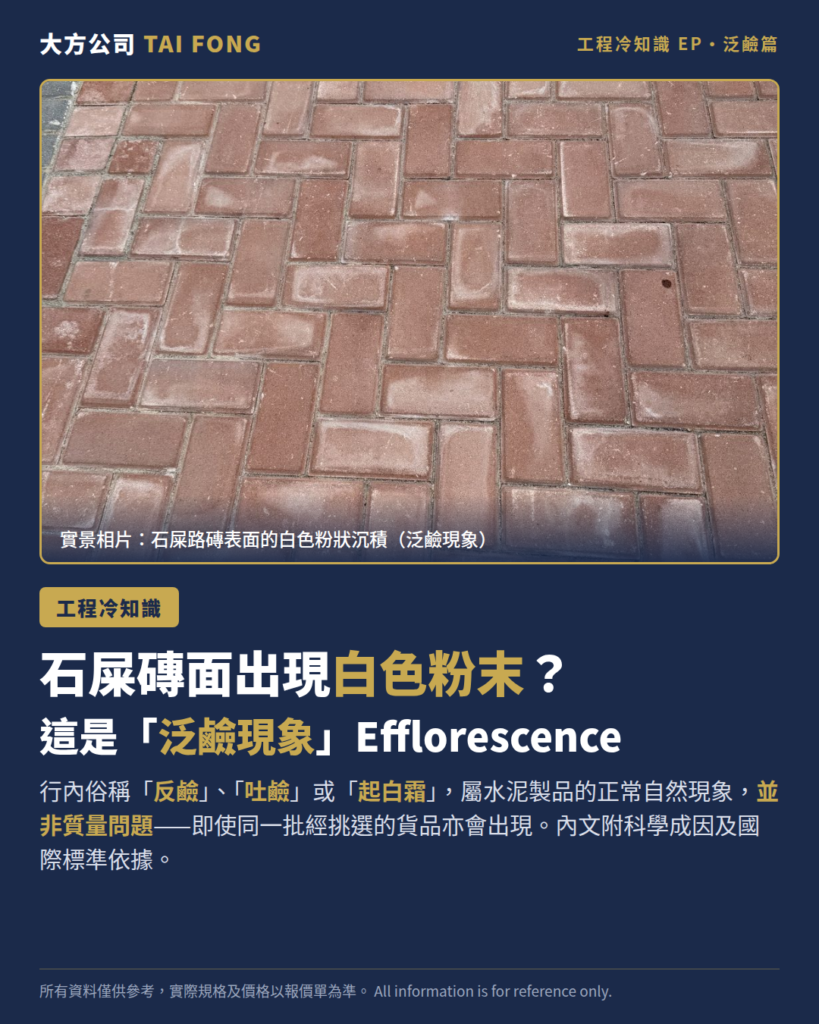
在預製英泥石屎行人路磚及馬路磚的驗收過程中,磚面偶爾會出現白色粉狀沉積物,即使是同一批經挑選的貨品,程度亦可能逐磚不同。此現象學名為「泛鹼」(Efflorescence),行內俗稱「反鹼」、「吐鹼」或「起白霜」,屬水泥製品的正常自然現象,並非質量缺陷。

成因
英泥(水泥)遇水硬化時,水化反應會產生氫氧化鈣(Ca(OH)2)。石屎內部佈滿微細毛細孔,當雨水或養護水分蒸發時,溶解了的氫氧化鈣會經毛細孔遷移至磚面,與空氣中的二氧化碳反應,生成白色的碳酸鈣結晶(Ca(OH)2 + CO2 → CaCO3 + H2O),即肉眼所見的白色粉末。

預製石屎磚以色粉、英泥及骨料倒入模具,常溫養護乾透成型,不經高溫燒製;相反,瓷磚經約1200°C窯燒後坯體玻璃化,游離石灰早已被消耗。石屎磚保留毛細孔結構及持續水化的水泥成分,故有機會出現泛鹼。而每塊磚的水分蒸發路徑各異,因此同一批貨品亦會有些磚反鹼、有些不會,屬材料特性使然。

國際標準定性
歐洲混凝土路磚標準 BS EN 1338:2003 明確指出,泛鹼不損害路磚的使用性能,不視為重大瑕疵;批次之間因原材料及養護條件的天然差異而顏色略有不同,亦屬正常情況。北美業界指引 CMHA/NCMA TEK 8-3A 及 ICPI Tech Spec 5 同樣界定泛鹼為自然現象,不影響強度、耐磨及防滑等結構性能。

處理方法
泛鹼隨雨水沖刷、日曬及行人磨擦,一般於數月至一兩年內自然淡化消失。如需加快處理,可用清水刷洗或專用清洗劑,避免使用強酸,以免侵蝕磚面。驗收建議以產品的整體外觀、強度及結構性能為準。
關於大方公司
大方公司始創於1983年,ISO 9001:2015認證,供應優質行人路磚、馬路磚、天然麻石、導盲磚及各類鋪路材料,長期參與建築署、路政署、房委會、拓展署及水務署工程項目。歡迎查詢。
電話:(852) 2390 3381
WhatsApp:6249 9534
電郵:[email protected]
網站:taifong.hk
參考文獻:BS EN 1338:2003 Concrete paving blocks – Requirements and test methods; CMHA/NCMA TEK 8-3A Control and Removal of Efflorescence; ICPI Tech Spec 5.
所有資料僅供參考,實際規格及價格以報價單為準。
What Is the White Powder on Concrete Paving Blocks? Understanding Efflorescence
[Engineering Knowledge]
During inspection of precast concrete footpath and roadway paving blocks, a white powdery deposit may occasionally appear on block surfaces, with the degree varying block by block even within the same selected batch. The phenomenon is technically known as efflorescence, commonly called “lime bloom” or “white frost”. It is a normal, natural characteristic of cement-based products and is not a quality defect.
Cause
When cement hardens with water, the hydration reaction produces calcium hydroxide, Ca(OH)2. Concrete contains fine capillary pores; as rain or curing moisture evaporates, dissolved calcium hydroxide migrates through these pores to the block surface, where it reacts with carbon dioxide in the air to form white calcium carbonate crystals (Ca(OH)2 + CO2 -> CaCO3 + H2O) — the white powder visible to the eye.
Precast concrete blocks are made from pigment, cement and aggregate cast into moulds and air-cured until set, with no kiln firing. Ceramic tiles, fired at around 1200 degrees C, vitrify and consume their free lime. Concrete blocks retain capillary pores and hydrating cement, so bloom can occur; and as each block’s moisture evaporation path differs, some blocks in a batch may bloom while others do not. This is a property of the material itself.
International Standards
BS EN 1338:2003, the European standard for concrete paving blocks, states that efflorescence does not impair performance and is not considered a significant defect. Slight colour variation between batches, arising from natural differences in raw materials and curing conditions, is likewise normal under the standard. North American industry guidance, CMHA/NCMA TEK 8-3A and ICPI Tech Spec 5, similarly defines efflorescence as a natural occurrence with no effect on strength, abrasion or slip resistance.
Treatment
Efflorescence fades naturally with rain, sunlight and foot traffic, typically within a few months to a year or two. To remove it sooner, scrub with clean water or a purpose-made cleaner; avoid strong acids, which may etch the surface. Acceptance should be judged on overall appearance, strength and structural performance.
About Tai Fong Company
Tai Fong Company was established in 1983 and is ISO 9001:2015 certified, supplying quality paving blocks, kerbs, natural granite, tactile pavers and related paving materials, with long-term participation in ArchSD, HyD, HKHA, CEDD and WSD projects. Enquiries are welcome.
Tel: (852) 2390 3381
WhatsApp: 6249 9534
Email: [email protected]
Website: taifong.hk
References: BS EN 1338:2003 Concrete paving blocks – Requirements and test methods; CMHA/NCMA TEK 8-3A Control and Removal of Efflorescence; ICPI Tech Spec 5.
All information is for reference only. Actual specifications and prices are subject to formal quotation.